

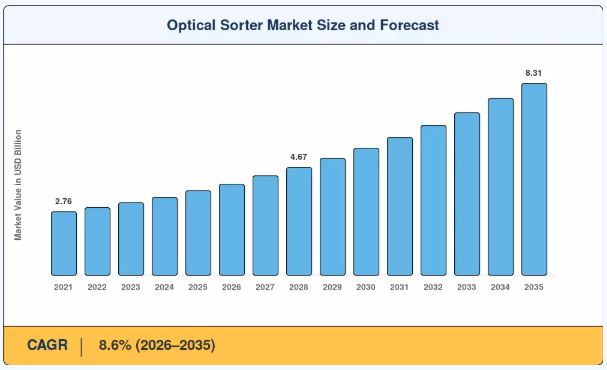
Optical Sorter Market Growth Analysis, 8.6% CAGR from USD 3.65B in 2025 to USD 8.31B in 2035
Optical Sorter Market
Optical Sorter Market Size, Share and Research Report By Technology (Camera Solutions, Near-Infrared, X-Ray Transmission, Hyperspectral Imaging, Laser Sorting)
The optical sorter market is expanding rapidly due to rising demand for automated quality inspection and efficient material separation across food, recycling, and mining industries.”
EINDHOVEN, NORTH BRABANT, NETHERLANDS, June 24, 2026 /EINPresswire.com/ -- The Global Optical Sorter market reached USD 3.65 billion in 2025 and is projected to climb from USD 3.96 billion in 2026 to USD 8.31 billion by 2035, expanding at an 8.6% CAGR during the forecast window. Optical sorters automated machine vision systems that use camera, near-infrared, X-ray transmission, hyperspectral imaging, and laser sensing technologies to identify and separate materials based on color, composition, and physical properties are becoming indispensable infrastructure across food processing, recycling, mining, and pharmaceutical operations worldwide. — Market Research Future (MRFR)
Two catalysts anchor this trajectory: tightening food safety mandates under the FDA’s New Era of Smarter Food Safety Blueprint, and Extended Producer Responsibility (EPR) frameworks rolling across EU member states and Southeast Asia that demand higher purity grades for recycled plastics and metals.
A profound technology shift is reshaping the optical sorter market landscape. Legacy single-spectrum camera systems are giving way to AI-enhanced hyperspectral and near-infrared sorting machines capable of detecting sub-millimeter contaminants invisible to conventional sensors. Machine vision sorting systems attracted over USD 1.2 billion in venture and strategic funding between 2022 and 2024, with deep-learning defect recognition modules now embedded in roughly 38% of new belt-line installations.
Capital expenditure incentives including India’s Production Linked Incentive (PLI) scheme and the US Inflation Reduction Act have further accelerated procurement cycles for automated optical classification equipment, while color-based optical sorting platforms deployed across South Asia and sub-Saharan Africa now process throughputs 40% higher than mechanical predecessors.
Get Full PDF Sample Copy of Report: (Including Full TOC, List of Tables & Figures, Chart) @
https://www.marketresearchfuture.com/sample_request/5731
➤ How Significant Is the Optical Sorter Market’s Growth?
The optical sorter market’s trajectory from USD 3.65 billion in 2025 to a projected USD 8.31 billion by 2035 represents more than a doubling over the forecast decade, reflecting the structural convergence of food safety regulation, circular-economy legislation, and persistent labor shortages that are collectively accelerating automated optical classification adoption across global processing and recycling infrastructure.
Camera-based systems captured 36.5% of the optical sorter market share in 2025, reflecting widespread adoption of color-based optical sorting across food and recycling lines, while near-infrared sorting machines are projected to register a 10.4% CAGR through 2035 the fastest among all technology segments — as hyperspectral capabilities expand into mining and textile recovery applications.
By platform, belt-based configurations accounted for 58.2% of the market in 2025, favored for their scalability in high-volume food grain optical sorters and municipal recycling facilities. Food processing held a commanding 62.0% revenue share by end-user industry in 2025, while the recycling segment is forecast to grow at an 11.2% CAGR, driven by EPR mandates requiring automated optical classification of post-consumer waste streams.
➤ What Does the Future Hold for the Optical Sorter Market?
Regulatory tightening around food safety is providing sustained, policy-backed demand for automated optical classification. The FDA’s New Era of Smarter Food Safety initiative allocated USD 68 million in fiscal 2024 for tech-enabled traceability and contaminant detection, directly incentivizing processors to replace manual inspection stations with automated optical sorters. Parallel regulatory frameworks across the EU and Asia are establishing comparable compliance-driven procurement cycles, positioning food safety mandates as one of the most durable near-term demand drivers for the market.
Extended Producer Responsibility and circular-economy legislation is reshaping recycling infrastructure investment globally. In France, India, and South Korea, EPR regimes now oblige packaging companies to fund recycling infrastructure that meets high purity requirements, and capital investment connected to EPR in sorting technology increased by 31% year-over-year in 2024, with the majority of new installations at material recovery facilities being near-infrared sorting machines and color-based optical sorting systems. This legislative wave is expanding the optical sorter market across both developed and developing economies as governments mandate higher recycled-material purity standards.
AI-driven hyperspectral imaging diffusion is transforming sorting accuracy and throughput economics. Deep-learning algorithms applied to hyperspectral sensor data now enable real-time classification of more than 200 material types at belt speeds exceeding 4 m/s, and a 2024 study found that AI-infused food grain optical sorters reduced false-rejection rates by 52% compared with rule-based systems directly improving yield economics for processors and spurring upgrade cycles across the market.
Persistent labor shortages are reinforcing this trend: the US Bureau of Labor Statistics reported 560,000 unfilled manufacturing positions in early 2025, and automated optical classification lines reduce headcount requirements on inspection stations by 60–75%, making the return-on-investment case compelling within 18 months for high-throughput food and recycling operators.
➤ Who Are the Key Players in the Optical Sorter Market?
The optical sorter market is served by a concentrated group of specialized machine vision and sensor-based sorting technology leaders with deep application expertise across food, recycling, mining, and pharmaceutical verticals. MRFR identifies the following key participants:
★TOMRA Systems ASA — the global market leader in sensor-based sorting technology, providing optical sorters for food processing, recycling, and mining applications with industry-leading near-infrared, X-ray, and hyperspectral imaging capabilities deployed across more than 100 countries.
★Bühler Group — a leading Swiss process technology company offering advanced optical sorting solutions integrated within broader food and feed processing equipment lines, with deep expertise in grain, rice, and seed optical classification systems.
★Key Technology (a Duravant company) — a major provider of camera-based and laser optical sorting equipment for food processing applications, specializing in high-speed defect detection and foreign material removal for nuts, produce, and processed food manufacturers.
★Satake Corporation — a Japanese pioneer in optical sorting and grain processing technology, providing color-based optical sorting machines widely deployed across rice, grain, and food processing facilities in Asia-Pacific and global export markets.
★Sesotec GmbH — a German specialist in sensor-based sorting and contaminant detection systems, offering near-infrared and X-ray transmission optical sorters for plastics recycling, food safety, and pharmaceutical quality control applications.
★Steinert GmbH — a leading German provider of sensor-based sorting and separation technology for the recycling and mining industries, with strong capabilities in metal recovery and electronic waste material classification systems.
★Pellenc ST — a French innovator in optical sorting technology for waste recycling and recovery applications, providing high-throughput near-infrared and camera-based sorting systems for plastics, paper, and municipal solid waste material recovery facilities.
★National Recovery Technologies (a BHS company) — a US-based specialist in optical sorting systems for the recycling industry, providing near-infrared and camera-based sorters engineered for single-stream recycling and material recovery facility operations across North America.
Competitive dynamics in this market are increasingly shaped by the integration of AI-driven hyperspectral imaging capabilities, the emergence of sorting-as-a-service business models that lower capital barriers for smaller processors, and strategic expansion into emerging-market grain and mineral processing applications.
➤ What Are the Emerging Trends in the Optical Sorter Market?
Several transformational trends are redefining the optical sorter market’s evolution through 2035:
Regulatory Push for Safer Food Supply Chains: Tightening food safety mandates under frameworks including the FDA’s New Era of Smarter Food Safety Blueprint and EU Regulation 2021/382 are compelling food processors to replace manual inspection with automated optical classification, establishing a durable, policy-backed demand floor for the market.
Extended Producer Responsibility & Circular-Economy Legislation: EPR mandates across France, India, South Korea, and a growing list of jurisdictions are requiring packaging companies to fund recycling infrastructure capable of achieving high material purity standards, driving sustained capital investment in near-infrared and color-based optical sorting systems at material recovery facilities worldwide.
AI-Driven Hyperspectral Imaging Diffusion: Deep-learning algorithms applied to hyperspectral sensor data are enabling real-time classification of 200+ material types at high belt speeds, substantially reducing false-rejection rates and improving yield economics — a step-change capability that is accelerating upgrade cycles across food, recycling, and mining applications.
Textile-to-Fiber Recycling Expansion: Growing regulatory and consumer pressure around textile waste is creating a significant emerging application for optical sorting technology, as recyclers deploy hyperspectral and near-infrared systems to classify mixed-fiber textile waste streams by polymer composition ahead of mechanical or chemical fiber recovery processes.
Sorting-as-a-Service Business Models: Leading OEMs are exploring outcome-based and equipment-as-a-service models that lower the capital barrier for smaller food processors and recycling operators, bundling optical sorter hardware with maintenance, software upgrades, and performance guarantees to expand the addressable customer base.
Emerging-Market Grain & Mineral Processing Modernization: Government-backed capital expenditure programs including India’s PLI scheme and the US Inflation Reduction Act are accelerating the modernization of grain processing and mineral sorting infrastructure across emerging markets, with color-based optical sorting platforms in South Asia and sub-Saharan Africa already delivering 40% higher throughput than legacy mechanical sorting equipment.
Get access to the full description of the report @
https://www.marketresearchfuture.com/reports/optical-sorter-market-5731
➤ How Is the Optical Sorter Market Segmented?
The optical sorter market report provides a comprehensive segmentation framework:
By Technology: Camera Solutions, Near-Infrared (NIR), X-Ray Transmission, Hyperspectral Imaging, Laser Sorting
By Platform: Belt, Freefall, Chute/Lane
By End-User Industry: Food Processing, Recycling, Mining, Pharmaceuticals
By Region: North America, Europe, Asia-Pacific, South America, Middle East and Africa
➤ What Are the Regional Insights from the Optical Sorter Market?
North America commanded a 36.2% revenue share of the global optical sorter market in 2025, driven by sustained USDA and EPA compliance spending alongside strong demand from the region’s large-scale food processing and recycling infrastructure. The United States’ elevated manufacturing labor shortages with 560,000 unfilled positions reported in early 2025 — are reinforcing the business case for automated optical classification across food, recycling, and pharmaceutical processing facilities throughout the region.
Europe holds the second-largest regional share at roughly 27%, underpinned by stringent circular-economy legislation, deposit-return schemes, and EU Regulation 2021/382 food safety compliance requirements. Germany and France serve as critical innovation and manufacturing hubs for the market, home to leading suppliers Sesotec, Steinert, and Pellenc ST, whose technology is widely deployed across the region’s advanced material recovery facility network and food processing industry.
Asia-Pacific is the fastest-growing region at an 11.2% CAGR through 2035, propelled by rising automation in China’s recycling sector and India’s grain processing modernization. Government investment programs supporting food grain optical sorters and circular-economy infrastructure, combined with Japan’s established optical sorting equipment manufacturing base led by Satake Corporation, are positioning the region as both a major demand center and a growing production hub for optical sorting technology.
South America and the Middle East & Africa represent emerging growth markets for the optical sorter market, with adoption driven by expanding food export processing capacity, growing mining sector automation investment, and the gradual development of formal recycling infrastructure across Brazil, South Africa, and Gulf Cooperation Council states. While these regions currently account for smaller shares of global revenue, rising government investment in food safety compliance and circular-economy infrastructure is expected to support above-average growth rates through 2035.
➤➤➤ Regional & Country-Level Reports by Market Research Future:
US Optical Sorter Market -
https://www.marketresearchfuture.com/reports/us-optical-sorter-market-16806
➤➤➤ Industry Analysis Reports by Market Research Future:
Payday Loans Market-
https://www.marketresearchfuture.com/reports/payday-loans-market-24681
Tax Advisory Services Market-
https://www.marketresearchfuture.com/reports/tax-advisory-services-market-24697
Trade Finance Market-
https://www.marketresearchfuture.com/reports/trade-finance-market-24698
Crypto Payment Gateway Market-
https://www.marketresearchfuture.com/reports/crypto-payment-gateway-market-24736
Atm Market-
https://www.marketresearchfuture.com/reports/atm-market-28768
Angel Funds Market-
https://www.marketresearchfuture.com/reports/angel-funds-market-29715
Capital Restructuring Service Market-
https://www.marketresearchfuture.com/reports/capital-restructuring-service-market-29740
Directors And Officers Insurance Market-
https://www.marketresearchfuture.com/reports/directors-and-officers-insurance-market-29752
Data Center Transformer Market-
https://www.marketresearchfuture.com/reports/data-center-transformer-market-30190
Smart Plug Market-
https://www.marketresearchfuture.com/reports/smart-plug-market-31109
Sagar Kadam
Market Research Future
+ +1 628-258-0071
email us here
Legal Disclaimer:
EIN Presswire provides this news content "as is" without warranty of any kind. We do not accept any responsibility or liability for the accuracy, content, images, videos, licenses, completeness, legality, or reliability of the information contained in this article. If you have any complaints or copyright issues related to this article, kindly contact the author above.
