

[Latest] Supply Chain Management (SCM) Market Size Will Attain USD 91.83 Billion by 2034 Registering a Promising CAGR of 12.48% - Exclusive Report by ZMR | Global Supply Chain Management (SCM) Market Size, Share, Trends Analysis Report
NEW YORK, USA, June 03, 2026 (GLOBE NEWSWIRE) -- Zion Market Research has published a new research report titled “Supply Chain Management (SCM) Market By Component (Services and Solutions), By Deployment (Cloud-Based and On-Premises), By Organization (Large Enterprises and Small & Medium Sized Enterprises), By Vertical (Transportation & Logistics, Retail & E-commerce, Healthcare, Food & Beverages, Industrial, and Others), and By Region - Global and Regional Industry Overview, Market Intelligence, Comprehensive Analysis, Historical Data, and Forecasts 2025 - 2034” in its research database.
“According to the latest research study, the global supply chain management (SCM) market size was valued at around USD 31.84 billion in 2024. The market is expected to grow at a CAGR of 12.48% and is anticipated to reach a value of USD 91.83 billion by 2034.”

Get a Free Sample PDF of this Research Report for more Insights - https://www.zionmarketresearch.com/sample/supply-chain-management-scm-market
(Before you plan to buy, sample reports are a great option to examine our in-depth studies or reports)
Supply Chain Management (SCM) Market Overview:
Supply chain management (SCM) refers to the end-to-end coordination and optimization of an organization's entire production and distribution process, encompassing the flow of raw materials, information, and finished goods from initial sourcing through final delivery to the end customer. It is a multifaceted discipline that involves managing relationships and operational workflows across a diverse network of stakeholders, including suppliers, manufacturers, distributors, retailers, and consumers. Effective SCM employs a range of strategic methodologies such as agile SCM, lean SCM, Six Sigma, resilient SCM, and digital SCM, all aimed at streamlining operations, minimizing inefficiencies, and ensuring that each stage of the production and fulfillment process is executed with precision and timeliness. The benefits of a well-optimized supply chain extend beyond operational efficiency to encompass both monetary and non-monetary gains, including reduced waste, lower operational costs, enhanced brand reputation, improved customer satisfaction, and stronger competitive positioning in the global marketplace.
The global SCM market is shaped by several interconnected dynamics that collectively influence its growth trajectory. On the demand side, the explosive growth of e-commerce and quick commerce sectors is creating an urgent need for sophisticated supply chain infrastructures that can deliver products to consumers rapidly and accurately. The globalization of trade is further intensifying this demand, as businesses operating across multiple markets require advanced coordination tools to manage geographically dispersed supplier and distributor networks. Simultaneously, the integration of transformative digital technologies such as Artificial Intelligence (AI), Machine Learning (ML), blockchain, and real-time data analytics is reshaping how supply chains are designed and managed, enabling predictive decision-making, improved visibility, and enhanced agility. However, the market also faces headwinds in the form of high implementation costs that create financial barriers, particularly for small and medium-sized enterprises, and growing concerns around data privacy and cybersecurity that pose significant operational and reputational risks for organizations adopting digital SCM solutions.
Report Scope:
| Report Attribute | Report Details |
| Market Size in 2024 | USD 31.84 Billion |
| Market Forecast in 2034 | USD 91.83 Billion |
| Growth Rate | CAGR of 12.48% |
| Base Year | 2024 |
| Forecast Years | 2025- 2034 |
| Key Companies Covered | Manhattan Associates, Oracle, Coupa Software, Descartes Systems Group, Logility, RELEX Solutions, SAP, Blue Yonder, Kinaxis, JDA Software, Ivalua, Infor, E2open, Epicor, OMP, and others. |
| Segments Covered | By Component, By Deployment, By Organization, By Vertical, and By Region |
| Regions Covered | North America, Europe, Asia Pacific, Latin America, and the Middle East & Africa |
| Customization Scope | Avail customized purchase options to meet your exact research needs. |
Directly Purchase a Copy of the Report | Quick Delivery Available - https://www.zionmarketresearch.com/buynow/su/supply-chain-management-scm-market
Key Insights
- As per the analysis, the supply chain management (SCM) market share is likely to grow at a CAGR of around 12.48% between 2025 and 2034.
- The supply chain management (SCM) market size was worth around $31.84 billion in 2024 and is estimated to hit approximately $91.83 billion by 2034. Due to a variety of driving factors, the market is predicted to rise at a significant rate.
- The Supply Chain Management (SCM) market is projected to grow at a significant rate due to the rapid expansion of the e-commerce and quick commerce industries, which are driving demand for agile and digitally enabled supply chain solutions.
- Based on the Component, the Solutions segment dominates the global SCM market, accounting for around 62% of global revenue in 2024, driven by the widespread adoption of advanced SCM software, analytics platforms, and enterprise-grade tools that enhance operational efficiency and real-time decision-making capabilities.
- Based on the Deployment, the Cloud-Based segment commands the largest market share at approximately 61.05% in 2024, owing to its superior flexibility, scalability, cost-efficiency, and ability to provide seamless remote access across distributed supply chain networks.
- Based on the Organization, the Large Enterprises segment leads the market with a share of more than 69% of total revenue in 2024, as large-scale businesses continue to invest heavily in AI-driven and integrated SCM platforms to manage complex, multi-tiered global supply chains.
- Based on the Vertical, the Transportation & Logistics segment dominates with over 31% of global revenue in 2024, fueled by trade globalization, evolving consumer delivery expectations, and rising demand for route optimization and freight visibility solutions.
- Based on Region, North America dominates the global SCM market with approximately 40% of global revenue in 2024, supported by the rapid integration of AI- and ML-powered SCM solutions, strong presence of leading technology vendors, and growing demand for data analytics across enterprises of all sizes.
Supply Chain Management (SCM) Market: Dynamics
Growth Drivers
How will e-commerce expansion influence growth in the Supply Chain Management (SCM) market?
The global Supply Chain Management (SCM) market is expected to be significantly driven by the rapid and sustained expansion of the e-commerce and quick commerce industries. E-commerce has emerged as one of the most powerful catalysts for SCM demand worldwide, compelling businesses to establish robust, responsive, and digitally integrated supply chain infrastructures capable of handling large order volumes while ensuring timely last-mile delivery to customers across diverse geographies. The ability to effectively manage inventory, coordinate logistics, and deliver products to remote locations in a consistent and cost-efficient manner has become a critical differentiator for e-commerce players, making advanced SCM solutions an operational necessity rather than a discretionary investment.
Compounding this demand is the meteoric rise of quick commerce, which demands ultra-fast delivery windows — often within minutes or hours — with near-zero tolerance for fulfillment errors. This hyper-speed commerce model requires real-time inventory visibility, automated replenishment systems, and tightly coordinated logistics networks that only modern, AI-enabled supply chain management platforms can provide. The convergence of e-commerce and quick commerce growth is, therefore, driving widespread adoption of agile and digital SCM solutions among both large enterprises and growing mid-market players seeking to remain competitive in an increasingly demanding consumer landscape.
Trade globalization is expected to accelerate revenue in the SCM industry during the forecast period
The increasing globalization of trade represents another powerful growth driver for the Supply Chain Management (SCM) market, as organizations across sectors expand their operations into new and emerging markets to capture growth opportunities and diversify revenue streams. Operating at a global scale inherently amplifies the complexity of supply chain coordination, requiring companies to manage multiple international suppliers, cross-border logistics providers, regional distributors, and local retailers simultaneously. This complexity creates a strong demand for advanced SCM platforms capable of delivering end-to-end visibility, seamless stakeholder communication, and real-time performance monitoring across geographically dispersed networks.
Furthermore, global trade serves as an essential risk mitigation strategy for businesses facing economic uncertainty, geopolitical disruptions, or supply shortages in specific regions. By establishing diverse supplier bases across different countries, companies can build resilient supply chains that are less vulnerable to single-point failures. This strategic imperative is encouraging organizations to invest in intelligent SCM systems that offer scenario planning, supply chain risk assessment, and dynamic sourcing capabilities, thereby further accelerating market revenue growth throughout the forecast period.
Restraints
What will be the impact of high investment cost on the Supply Chain Management (SCM) market?
The global Supply Chain Management (SCM) industry faces a notable restraint in the form of the substantial capital investment required to deploy and maintain modern SCM technologies. Implementing comprehensive SCM systems encompassing software licenses, hardware infrastructure, integration services, employee training, and ongoing support entails considerable upfront and recurring expenditure that can be prohibitive for many organizations, particularly those operating in cost-sensitive environments or at smaller scales. The deployment cost for large enterprises alone can run into the millions of dollars, creating a significant financial barrier that limits broader market penetration.
This challenge is further exacerbated by prevailing global economic volatility, including inflationary pressures, fluctuating currency exchange rates, and tightening credit conditions, all of which constrain the capital budgets of businesses worldwide. Small and medium-sized enterprises (SMEs), in particular, face disproportionate challenges in justifying the return on investment for full-scale SCM deployments, often leading them to rely on legacy systems or fragmented point solutions that fall short of delivering the operational efficiencies offered by modern integrated platforms. This disparity in adoption rates between large and smaller enterprises continues to act as a structural restraint on the overall growth potential of the SCM market.
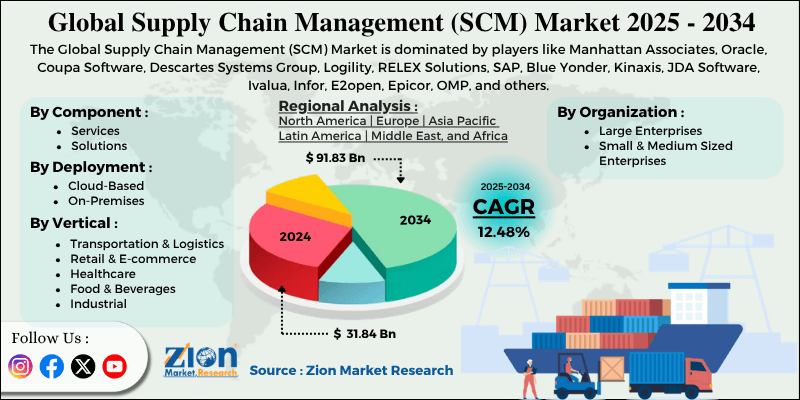
Browse the full “Supply Chain Management (SCM) Market By Component (Services and Solutions), By Deployment (Cloud-Based and On-Premises), By Organization (Large Enterprises and Small & Medium Sized Enterprises), By Vertical (Transportation & Logistics, Retail & E-commerce, Healthcare, Food & Beverages, Industrial, and Others), and By Region - Global and Regional Industry Overview, Market Intelligence, Comprehensive Analysis, Historical Data, and Forecasts 2025 - 2034” Report at https://www.zionmarketresearch.com/report/supply-chain-management-scm-market
Supply Chain Management (SCM) Market: Segmentation
The global Supply Chain Management (SCM) market is segmented by component, deployment, organization, vertical, and region.
Based on the Component Segment, the Supply Chain Management (SCM) market is divided into Services and Solutions. The Solutions segment is the most dominant category within the component segment, accounting for approximately 62% of global revenue in 2024, driven by the surging enterprise adoption of sophisticated SCM software suites, predictive analytics platforms, demand planning tools, and procurement management solutions. Organizations across industries are increasingly investing in end-to-end SCM software platforms that provide integrated visibility and control across the entire supply chain, replacing fragmented legacy systems with unified digital architectures. The scalability and customizability of modern SCM solutions, combined with their ability to integrate seamlessly with existing ERP and CRM systems, further reinforce their dominant market position and are expected to sustain a CAGR of over 13.01% during the forecast period. The Services sub-segment, while smaller in revenue contribution, is experiencing accelerating growth driven by the rising demand for cloud-based Software-as-a-Service (SaaS) delivery models, managed services, and professional consulting engagements, as organizations seek external expertise to optimize their supply chain operations without incurring the full cost of in-house capability development.
Based on the Deployment Segment, the Supply Chain Management (SCM) market is divided into Cloud-Based and On-Premises. The Cloud-Based segment is the dominant deployment mode, commanding approximately 61.05% of global revenue in 2024 and projected to grow at a CAGR of 12.09% during the forecast period. The overwhelming preference for cloud-based SCM deployment is underpinned by several compelling advantages over traditional on-premises systems, including significantly lower upfront capital expenditure, greater operational flexibility, seamless scalability to accommodate fluctuating business volumes, and the ability to access supply chain data and management tools remotely from any location. Cloud platforms also enable faster implementation timelines and facilitate real-time collaboration among geographically dispersed supply chain stakeholders. The accelerating shift toward hybrid and multi-cloud enterprise IT architectures is further embedding cloud-based SCM solutions as the preferred choice for organizations undergoing digital transformation. The On-Premises sub-segment retains relevance primarily among industries with stringent data sovereignty requirements or complex legacy system integration needs, particularly in regulated sectors such as defense, government, and critical infrastructure.
Based on the Organization Segment, the Supply Chain Management (SCM) market is divided into Large Enterprises and Small & Medium Sized Enterprises (SMEs). The Large Enterprises segment dominates the market, contributing more than 69% of total revenue in 2024 and projected to sustain a CAGR of 13.07% throughout the forecast period. Large enterprises possess the financial resources, technical infrastructure, and organizational capacity to invest in comprehensive, AI-driven SCM platforms that can manage the complexity of their sprawling global supply chains, which often involve thousands of suppliers, multiple manufacturing facilities, and distribution networks spanning numerous countries. The growing imperative to build supply chain resilience in the aftermath of global disruptions has prompted large enterprises to accelerate their SCM technology investments, with particular emphasis on predictive analytics, real-time risk monitoring, and automated replenishment systems. The SME sub-segment, while currently a smaller revenue contributor, is gaining traction through the adoption of cloud-based, subscription-model SCM solutions that offer enterprise-grade functionality at a fraction of the cost of traditional deployments, gradually democratizing access to advanced supply chain management tools.
Based on the Vertical Segment, the Supply Chain Management (SCM) market is divided into Transportation & Logistics, Retail & E-commerce, Healthcare, Food & Beverages, Industrial, and Others. The Transportation & Logistics vertical is the most dominant segment, accounting for over 31% of global revenue in 2024 and expected to maintain its leadership with a CAGR of 15.01% during the forecast period. This dominance is attributable to the fundamental and deeply embedded role that SCM plays in the logistics industry, where the ability to efficiently plan routes, track shipments in real time, manage carrier relationships, and optimize warehouse operations is directly linked to profitability and service quality. The escalating complexity of global freight networks, driven by the growth of cross-border e-commerce, the expansion of multi-modal transportation, and increasing regulatory compliance requirements, is continuously elevating the strategic importance of advanced SCM solutions for logistics operators. The Retail & E-commerce vertical represents the second most dominant segment, as the relentless growth of online retail creates persistent and intensifying demand for SCM platforms that can manage high-velocity order fulfillment, dynamic inventory replenishment, efficient returns processing, and seamless omnichannel customer experiences.
Regional Scope:
Why will North America continue to dominate the global Supply Chain Management (SCM) market during the projection period?
North America stands as the undisputed leader in the global Supply Chain Management (SCM) market and is expected to maintain its dominant position throughout the forecast period. The region's supremacy is driven by a powerful combination of technological leadership, mature enterprise adoption, and the presence of a dense ecosystem of world-class SCM solution providers and innovative technology companies. The United States, in particular, serves as the epicenter of SCM innovation, housing some of the most influential technology vendors, logistics giants, and research institutions that collectively shape global supply chain management standards and practices. The widespread integration of AI, ML, and big data analytics into enterprise SCM platforms across North American businesses is further reinforcing regional leadership, enabling organizations to achieve unprecedented levels of operational efficiency, demand forecasting accuracy, and supply chain resilience.
Europe represents the second-largest regional market for Supply Chain Management (SCM) solutions and is expected to deliver steady growth throughout the projection period, supported by a unique combination of factors that reflect the region's commitment to sustainable and technologically advanced supply chain practices. Germany, the United Kingdom, and France emerge as the dominant markets within Europe, each driven by strong manufacturing bases, sophisticated logistics networks, and progressive regulatory frameworks that incentivize supply chain transparency and sustainability. The European Union's increasingly stringent environmental regulations and corporate sustainability mandates are compelling organizations across industries to redesign their supply chains around circular economy principles, green logistics, and carbon reduction strategies, creating substantial demand for SCM platforms with sustainability tracking and reporting capabilities.
The Asia Pacific region is anticipated to be one of the fastest-growing markets for Supply Chain Management (SCM) solutions during the forecast period, fueled by the region's extraordinary manufacturing output, rapidly expanding e-commerce ecosystems, and accelerating digital transformation initiatives across emerging economies. China and India stand out as the primary growth engines within the region, with China's vast industrial base and e-commerce dominance driving intense SCM investment across retail, manufacturing, and logistics sectors, while India's burgeoning digital economy, infrastructure development programs, and growing consumer market are creating fresh demand for sophisticated supply chain management platforms. The proliferation of mobile technology, cloud computing infrastructure, and government-led digital economy initiatives across Southeast Asian markets, including Indonesia, Vietnam, and Thailand, is further broadening the SCM adoption base across the region.
Recent Developments
- In February 2026, FourKites, a prominent supply chain visibility and technology company, announced the launch of Loft, a groundbreaking AI orchestration platform engineered to bridge the gap between external network intelligence and internal enterprise data systems. This innovative platform enables broader enterprise system orchestration, moving organizations decisively away from conventional supply chain tracking tools toward a more intelligent and interconnected approach to supply chain management, significantly enhancing operational agility and decision-making speed for logistics and retail clients.
- In March 2026, Descartes Systems Group, recognized as a global leader in logistics and supply chain technology solutions, announced a major expansion of Artificial Intelligence capabilities within its Global Logistics Network (GLN). The company introduced Descartes MacroPoint OpsForce, a sophisticated suite of AI agents specifically engineered to automate freight visibility workflows, maintain uninterrupted tracking continuity across complex multi-carrier networks, and enable proactive exception management, thereby empowering logistics operators to deliver consistently superior service levels to their customers.
Request For Customization on This Report as Per Your Requirements - https://www.zionmarketresearch.com/custom/10542
Supply Chain Management (SCM) Market: Competitive Landscape
The report contains qualitative and quantitative research on the global supply chain management (SCM) market, as well as detailed insights and development strategies employed by the leading competitors.
Some of the main players in the global supply chain management (SCM) market include;
- Manhattan Associates
- Oracle
- Coupa Software
- Descartes Systems Group
- Logility
- RELEX Solutions
- SAP
- Blue Yonder
- Kinaxis
- JDA Software
- Ivalua
- Infor
- E2open
- Epicor
- OMP
The global supply chain management (SCM) market is segmented as follows:
By Component
- Services
- Solutions
By Deployment
- Cloud-Based
- On-Premises
By Organization
- Large Enterprises
- Small & Medium-Sized Enterprises
By Vertical
- Transportation & Logistics
- Retail & E-commerce
- Healthcare
- Food & Beverages
- Industrial
- Others
By Region
- North America
- The U.S.
- Canada
- Europe
- France
- The UK
- Spain
- Germany
- Italy
- Rest of Europe
- Asia Pacific
- China
- Japan
- India
- Southeast Asia
- Rest of Southeast Asia
- The Middle East & Africa
- GCC
- South Africa
- Rest of the Middle East & Africa
- Latin America
- Brazil
- Argentina
- Rest of Latin America
Request Free Brochure of the Global Supply Chain Management (SCM) Market @ https://www.zionmarketresearch.com/requestbrochure/supply-chain-management-scm-market
Key Questions Answered in This Report:
- What is supply chain management (SCM)?
- Which key factors will influence the supply chain management (SCM) market growth over 2025-2034?
- What will be the value of the supply chain management (SCM) market during 2025-2034?
- What will be the CAGR value of the supply chain management (SCM) market during 2025-2034?
- Which region will contribute notably towards the supply chain management (SCM) market value?
- Which are the major players leveraging the supply chain management (SCM) market growth?
- What can be expected from the global supply chain management (SCM) market report?
What are the key trends in the Supply Chain Management (SCM) Market?
- Sustainability Initiatives Reshaping Supply Chain Management Practices
Sustainability has emerged as a defining strategic trend in the global Supply Chain Management (SCM) market, fundamentally transforming how organizations design, operate, and measure the performance of their supply chains. Driven by a powerful combination of tightening government regulations, evolving investor expectations, and shifting consumer preferences toward environmentally responsible brands, businesses across industries are systematically integrating sustainability objectives into their core supply chain strategies. Key sustainability initiatives gaining significant traction include the reduction of carbon emissions across transportation and logistics operations through the adoption of electric and alternative-fuel vehicle fleets, the implementation of green logistics principles such as optimized load planning to reduce unnecessary freight movements, and the transition toward eco-friendly and recyclable packaging materials throughout the product distribution chain. SCM technology vendors are responding to this trend by embedding carbon footprint tracking, supplier sustainability scoring, and regulatory compliance reporting capabilities directly within their platforms, enabling organizations to monitor and improve their environmental performance in real time.
- Blockchain Integration Driving Transparency and Fraud Prevention in Supply Chains
Blockchain technology is rapidly gaining momentum as a transformative innovation in the Supply Chain Management (SCM) market, offering organizations an immutable, decentralized, and highly transparent mechanism for recording and verifying every transaction and movement of goods across the supply chain. By creating a shared, tamper-proof ledger that all authorized supply chain participants can access and contribute to, blockchain fundamentally addresses longstanding challenges around counterfeit product infiltration, supplier fraud, documentation falsification, and compliance verification — issues that cost global businesses billions of dollars annually. In industries such as pharmaceuticals, food and beverages, luxury goods, and electronics, where product authenticity and chain-of-custody integrity are critical to consumer safety and brand protection, blockchain-enabled SCM platforms are proving particularly valuable. The technology also streamlines trade finance and cross-border payment processes by reducing reliance on paper-based documentation and manual verification procedures, accelerating settlement timelines, and lowering transaction costs across international supply chain networks.
Browse Other Related Research Reports
- Satellite IoT Market Size, Share, Trends Analysis Report: https://www.fnfresearch.com/satellite-iot-market
- Electric Two-wheeler (E2W) Market Size, Share, Trends Analysis Report: https://www.fnfresearch.com/electric-two-wheeler-e2w-market
- Real-time Payment Market Size, Share, Trends Analysis Report: https://www.fnfresearch.com/real-time-payment-market
- Antibody Drug Conjugate (ADC) Market Size, Share, Trends Analysis Report: https://www.fnfresearch.com/antibody-drug-conjugate-adc-market
- Stroke Management Market Size, Share, Trends Analysis Report: https://www.fnfresearch.com/stroke-management-market
- Mental Health Apps Market Size, Share, Trends Analysis Report: https://www.fnfresearch.com/mental-health-apps-market
- Built-In Sanitary Napkin Market Size, Share, Trends Analysis Report: https://www.fnfresearch.com/built-in-sanitary-napkin-market
- Diabetes Management Market Size, Share, Trends Analysis Report: https://www.fnfresearch.com/diabetes-management-market
- Fish-Oil Omega-3 Market Size, Share, Trends Analysis Report: https://www.fnfresearch.com/fish-oil-omega-3-market
- Vegan Fast Food Market Size, Share, Trends Analysis Report: https://www.fnfresearch.com/vegan-fast-food-market
About Zion Market Research:
Zion Market Research is a leading market research organization offering industry expertise and scrupulous consulting services to clients for their business development. The reports and services offered by Zion Market Research are used by prestigious academic institutions, start-ups, and companies globally to measure and understand the changing international and regional business backgrounds.
Contact Us:
Zion Market Research
USA/Canada Toll Free: 1 (855) 465-4651 | Newark: 1 (302) 444-0166
India: +91 7768 006 007 | +91 7768 006 008
Email: sales@zionmarketresearch.com | Web: https://www.zionmarketresearch.com/
Follow Us on - LinkedIn | X | Facebook | Pinterest | YouTube


Legal Disclaimer:
EIN Presswire provides this news content "as is" without warranty of any kind. We do not accept any responsibility or liability for the accuracy, content, images, videos, licenses, completeness, legality, or reliability of the information contained in this article. If you have any complaints or copyright issues related to this article, kindly contact the author above.
